Sable Island Free Lab
Design Build 07/25/2024
Partners: Dalhousie University Free Lab, Maritime Lumber Bureau, Parks Canada.
Lab leaders: Nicholson Ceretti & Dominic Tweed.
Student Group: Vanessa Croft, Cole Fraser, Jordan Gallant, Blake Klotz, Nick Leech, Jacob Rusen-Steele, Sarah Shannon, Rob Tremayne, & Holly Wiersma.
In collaboration with Parks Canada researchers living on the island, this Free Lab explored prefabricated structural systems for a new visitor center on Sable Island.
Sable Island is a remote and dynamic landscape, shaped by high winds and a continuous terrain of shifting sand. With no trees and minimal shelter, the environment is fully exposed in all directions. Before human presence, the island’s only inhabitants were wild horses, seabirds, and seals.
The island is in constant motion—its geography perpetually reshaping. Existing light-frame buildings are only five years away from being overtaken by the sea, as the shoreline advances beyond their concrete foundations.
Our aim was to design a structure that could be relocated, withstand extreme wind, and address the logistical challenges of transporting materials to such an isolated site.
Designing the pavilion required careful consideration of how materials would reach Sable Island. The dimensions of the vehicles capable of accessing the island directly influenced the scale and form of our mass timber components.
There are only two ways to reach the island: by plane or by sea barge. Air delivery posed weight restrictions that would limit our design options. The barge, while more sustainable in terms of fossil fuel use and offering greater cargo capacity, only travels to the island twice a year, making it essential for our design to arrive as a complete, self-contained package.
The logistical thresholds didn’t stop at delivery. Once on-site, materials could only be moved by a three-person crew with access to a single Bobcat. During the pavilion's mock assembly in Halifax, we replicated this constraint, ensuring all mass timber panels remained within the manual handling capacity of the island crew.


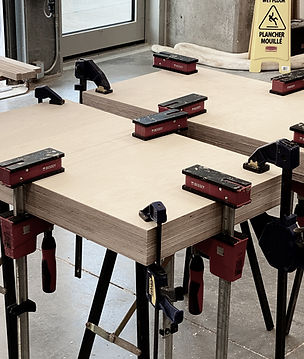
Given the island’s ever-shifting sandy terrain, our site model aimed to scale and simulate this dynamic landscape using a sand-casted mold that, when inverted, doubled as a table. LIDAR data was used to generate a 3D model of the island’s topography, which we CNC-milled into a block of LVL. This negative form allowed gravity to shape the sand into a physical model, enabling us to simulate the island’s environmental behavior.
By using sand as our medium, we were able to study how wind interacts with the built form. On Sable Island, high winds displace sand, causing it to accumulate against stationary structures. This natural movement gradually buries conventional foundations—such as the concrete bases supporting current Parks Canada buildings. Our model allowed us to test helical screw piles as an alternative foundation system, ensuring the pavilion could remain elevated and unobtrusive, allowing sand to move freely beneath it without compromising structural stability.
LVL Site Model



NLT
Light
Frame
DLT

